Table Of Content
- Here is How to Find the P-Value from the t-Distribution Table
- How to Find Sample Variance on a TI-84 Calculator
- Newborn screening (NBS) knowledge and awareness
- Are the Average-Based and the Individual-Based Approaches Related?
- Feasible when random assignment of participants is considered unethical
- Table of Contents
The longer the time lapse is between the pretest and the posttest, the higher the risk is for history to bias the study. A pretest-posttest design is an experiment in which measurements are taken on individuals both before and after they’re involved in some treatment. There were approximately 141 design & applied arts students who graduated with this degree at CSULB in the most recent data year. Degree recipients from the design & applied arts major at California State University - Long Beach earn $8,089 above the typical graduate with the same degree shortly after graduation. There were about 129 design & applied arts students who graduated with this degree at Otis College of Art and Design in the most recent year we have data available.
Here is How to Find the P-Value from the t-Distribution Table
Randomized controlled trials (RCTs) in which individuals are assigned to intervention or control (standard-of-care or placebo) arms are considered the gold standard for assessing causality and as such are a first choice for most intervention research. Random allocation minimizes selection bias and maximizes the likelihood that measured and unmeasured confounding variables are distributed equally, enabling any difference in outcomes between intervention and control arms to be attributed to the intervention under study. RCTs can also involve random assignment of groups (e.g., clinics, worksites or communities) to intervention and control arms, but a large number of groups are required in order to realize the full benefits of randomization.
How to Find Sample Variance on a TI-84 Calculator
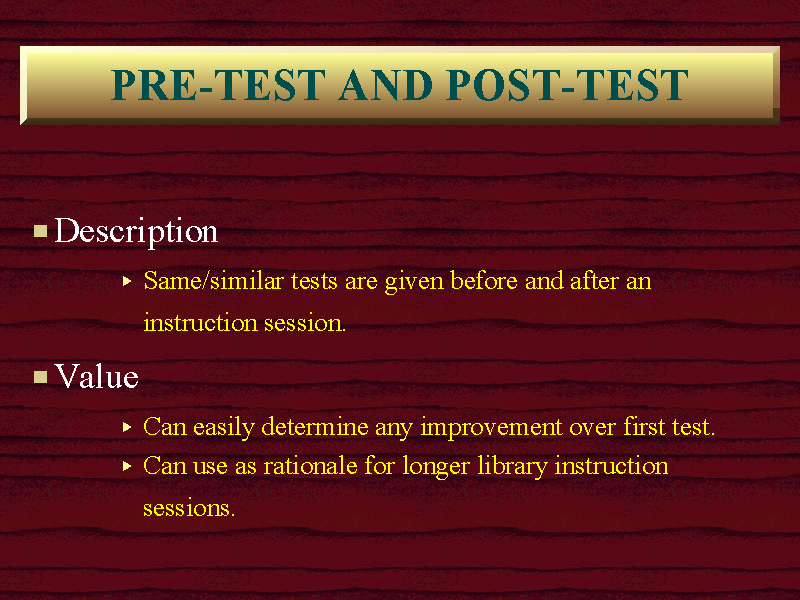
If you wanted a true experiment, then you would need additional steps to randomly sort your participants. A pretest is an assessment measure given to participants before they have undergone some type of treatment as part of a research study, while a posttest is an assessment measure given to participants after they have received treatment as part of a research study. A pretest-posttest research design, which is quasi-experimental, must provide participants with the same assessment measures before and after treatment in order to determine if any changes can be connected to the treatment.
Newborn screening (NBS) knowledge and awareness
The outcome of interest is measured 2 times, once before the treatment group gets the intervention — the pretest — and once after it — the posttest. However, this study chose non-communicable diseases (NCDs) due to their status as an emerging health challenge in the Rwandan healthcare system. NCDs are the leading cause of morbidity and mortality worldwide, and there is a growing and pressing burden of NCDs in developing countries [18]. As a developing country, Rwanda still has a large burden of infectious diseases, but NCDs are also an increasing burden to the Rwandan health system. The Ministry of Health report indicates that in Rwanda, there is a shift in disease burden where NCDs are becoming more prevalent and requests the adaptation of early screening [2].
How can I compare predictors between two groups in regression analysis? - ResearchGate
How can I compare predictors between two groups in regression analysis?.
Posted: Tue, 07 Aug 2018 07:00:00 GMT [source]
Statistical analysis methods include finding the mean, median, standard deviation, variance, reliability, and validity. Paired t-tests can be employed to determine statistical significance in the pretest and posttest scores of the participants. In particular, the Solomon four-group pretest-posttest design requires a high degree of statistical calculation because it has four groups instead of two. If a Solomon four-group design is desired, a meta-analysis may need to be conducted. A pretest is an assessment measure given to participants before they have undergone some type of treatment as part of a research study. A posttest is an assessment measure given to participants after they have received treatment as part of a research study.
“Statistical methods based on the General(ized) Linear Model (…) have optimal power when individuals behave identically (…). When there exists genuine, idiosyncratic variations in the effect of a factor, (…) the effect of a factor can be significant for every individual (…) while Student and Fisher tests yield a probability close to one if the population average is small enough” (Vindras et al., 2012, p. 2). Some believe that the before-after design is comparable to observational design and that only studies with a “comparator” group, as discussed above, are truly interventional studies. For each limitation below, we will discuss how it threats the validity of the study, as well as how to control it by manipulating the design (adding or changing the timing of observations). Statistical techniques can be used to control these limitations, but these will not be discussed here.
Feasible when random assignment of participants is considered unethical
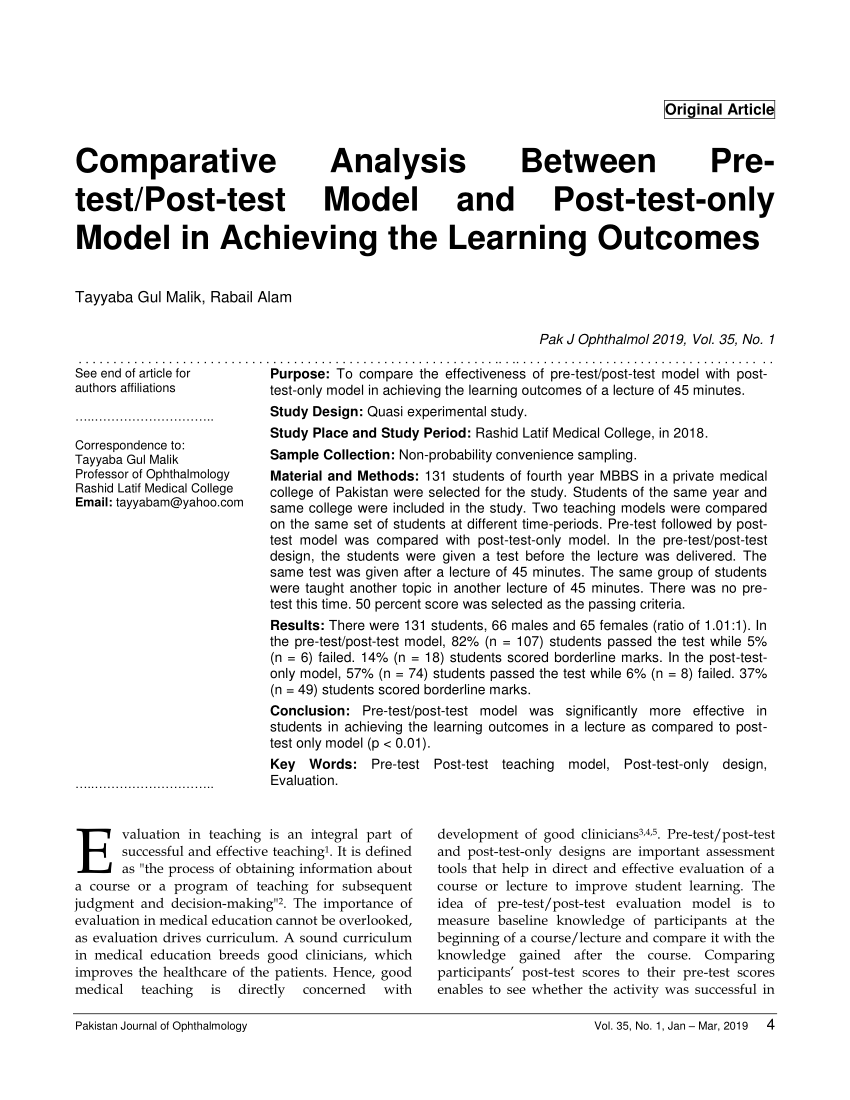
By using a pretest, a control group, and random assignment, this design controls all internal threats to validity. Pre-Post Test Designs are flexible; and can be used across non-experimental, experimental and quasi-experimental research settings. While it has a treatment group, it may or may not include a control group (Zach, 2020).
This can be hampered by the practice effect, defined as an influence on performance from previous experience. Instrumentation effect refers to changes in the measuring instrument that may account for the observed difference between pretest and posttest results. Note that sometimes the measuring instrument is the researchers themselves who are recording the outcome. The testing effect is the influence of the pretest itself on the outcome of the posttest. This happens when just taking the pretest increases the experience, knowledge, or awareness of participants which changes their posttest results (this change will occur irrespective of the intervention). History refers to events (other than the intervention) that take place in time between the pretest and posttest and can affect the outcome of the posttest.
In some cases, conducting a randomized controlled trial may be ethically unreasonable or simply not feasible, such as when there is an effective standard treatment available for a severe condition and it would be unethical to utilize a control group and withhold the treatment from them. Pre-post designs offer an alternative method for assessing the impact of an intervention without randomizing participants to different study arms. Pre-post designs can also be used within longitudinal studies to examine changes in outcomes over time in the same individuals or groups. By monitoring outcomes at multiple time points, researchers can observe the evolution of health-related variables and assess the effects of various factors on those variables.
In the SWD, there is a unidirectional, sequential roll- out of an intervention to clusters (or individuals) that occurs over different time periods. Initially all clusters (or individuals) are unexposed to the intervention, and then at regular intervals, selected clusters cross over (or ‘step’) into a time period where they receive the intervention [Figure 3 here]. All clusters receive the intervention by the last time interval (although not all individuals within clusters necessarily receive the intervention). Data is collected on all clusters such that they each contribute data during both control and intervention time periods. The order in which clusters receive the intervention can be assigned randomly or using some other approach when randomization is not possible. For example, in settings with geographically remote or difficult-to-access populations, a non-random order can maximize efficiency with respect to logistical considerations.
Investigation of the use of infographics to aid second language vocabulary learning Humanities and Social Sciences ... - Nature.com
Investigation of the use of infographics to aid second language vocabulary learning Humanities and Social Sciences ....
Posted: Wed, 15 Mar 2023 07:00:00 GMT [source]
According to the Ministry of Health in Rwanda, 85% of the burden of disease is addressed at the primary health care level, including community, health posts, and health centers [2]. At this healthcare system level, nurses use diagnosis procedures traditionally applied by physicians to assess and manage diseases, exposing them to risks for diagnostic errors. Nurses are responsible and accountable for patient care and work to their full potential without supervision at the health center. Stepped wedge designs (SWDs) involve a sequential roll-out of an intervention to participants (individuals or clusters) over several distinct time periods (5, 7, 22, 24, 29, 30, 38). SWDs can include cohort designs (with the same individuals in each cluster in the pre and post intervention steps), and repeated cross-sectional designs (with different individuals in each cluster in the pre and post intervention steps) (7).
This study investigated the feasibility of continuous professional development through VP cases to further train in-service nurses in clinical reasoning. One study showed that the pre-post effect size observed (i.e., the magnitude of change in distribution center) is the main determinant of the percentage of individuals showing pre-post change (Norman et al., 2001). This simulation study revealed that the relation between effect size and percentage of change is approximately linear for effect sizes below one, with normal and moderately skewed distributions, and regardless of the cutoff to detect a change. Therefore, at least under certain conditions, the mean change can yield some information about the percentage of individual changes. A later study using empirical data found consistent results (Lemieux et al., 2007). However, these papers did not report any mathematical function to estimate the percentage of changes based on the change in the distribution center, nor did they report the fit that such a function may achieve, which would be useful to assess the quality of its estimations.
In this design, a variable of interest is measured before and after an intervention in the same participants. This sometimes leads to confusion between interventional and prospective cohort study designs. For instance, the study design in the above example appears analogous to that of a prospective cohort study in which people attending a wellness clinic are asked whether they take aspirin regularly and then followed for a few years for occurrence of cerebrovascular events. The basic difference is that in the interventional study, it is the investigators who assign each person to take or not to take aspirin, whereas in the cohort study, this is determined by an extraneous factor. The difference between the pretest and posttest measures will estimate the intervention’s effect on the outcome.
Of course, when possible, computing the actual empirical value is preferable. This design has the advantages of (i) each participant serving as his/her own control, thereby reducing the effect of interindividual variability, and (ii) needing fewer participants than a parallel-arm RCT. However, this design can be used only for disease conditions which are stable and cannot be cured, and where interventions provide only transient relief. For instance, this design would be highly useful for comparing the effect of two anti-inflammatory drugs on symptoms in patients with long-standing rheumatoid arthritis.




No comments:
Post a Comment